About St. Kitts & Nevis, the twin islands
Official tourism and investment promoters of St. Kitts & Nevis. Learn about St. Kitts, Nevis and the two islands together, their history, heritage and highlights.
Explore St. Kitts & Nevis is the editorial travel guide to the two-island Caribbean nation, with island directories, guides and live conditions. This page needs JavaScript for its interactive maps, photography and live data - the links below work without it.
Two islands, one federation
St. Kitts and Nevis is the smallest sovereign state in the Americas by both area and population, made up of two volcanic islands in the northern Leeward Islands. The federation became independent from the United Kingdom on 19 September 1983 and remains a Commonwealth realm with a parliamentary system; Nevis holds its own island administration alongside the federal government in Basseterre. English is the official language, the East Caribbean dollar is the currency, and the two islands are separated by The Narrows, a channel crossed daily by passenger ferry and water taxi.
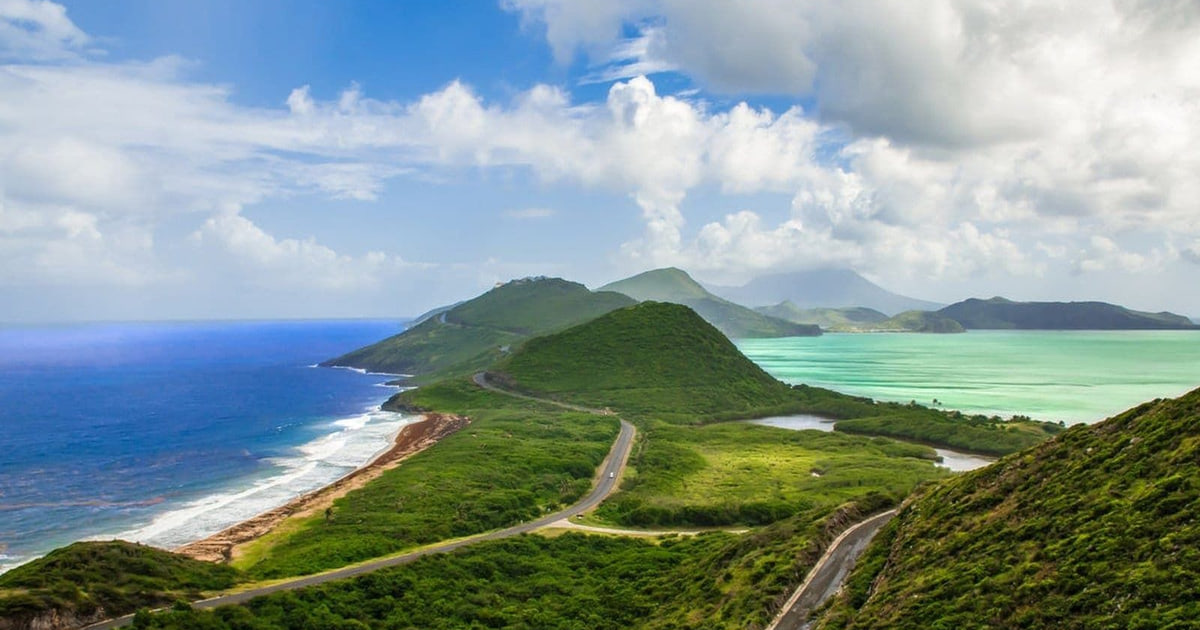
The geography of both islands is the product of volcanism. St. Kitts runs north-west to south-east along a central ridge that rises to Mount Liamuiga, a dormant stratovolcano with a crater lake basin at its summit, and tapers into a dry, low-lying south-east peninsula ringed by beaches. Nevis is almost circular, built around the single forested cone of Nevis Peak, with hot springs at Bath and a shoreline of long west-coast strands and rockier Atlantic bays. Read each island in detail in St. Kitts and Nevis, or see how they work as one trip in the twin islands overview.
A layered history
The islands were settled by Amerindian peoples long before European contact; the Kalinago name for St. Kitts, Liamuiga, meaning fertile land, survives in the name of its volcano. Columbus charted the islands in 1493, and in 1624 St. Kitts became the first English colony in the Caribbean, earning it the epithet "the Mother Colony of the West Indies". A long period of Anglo-French rivalry followed, and the fortifications built during it remain the most visible legacy of the era.
Brimstone Hill Fortress National Park, inscribed on the UNESCO World Heritage list in 1999, stands roughly 230 metres above the west coast and was constructed by enslaved African labourers over more than a century. Sugar shaped everything that followed: plantation estates covered both islands, several now operate as inns and restaurants, and the narrow-gauge railway built to carry cane now runs as the St. Kitts Scenic Railway. The last sugar harvest was in 2005, and the industry's closure is the reason tourism, services and light manufacturing dominate the economy today. Heritage sites, museums and monuments are listed in attractions.
Nevis carries its own history. Charlestown's Georgian core includes the birthplace of Alexander Hamilton, and the island was where Horatio Nelson married Frances Nisbet in 1787. Its reputation as an eighteenth-century spa destination - the "Queen of the Caribbees" - came from the thermal springs that still flow near the Bath Hotel.
Culture, food and the calendar
Kittitian and Nevisian culture is built on African, British and wider Caribbean influences, expressed through string band and steel pan music, soca and calypso, masquerade troupes, and a food culture centred on saltfish, breadfruit, plantain, fresh-caught fish and lobster. Goat water, a slow-cooked stew, is closely associated with Nevis; conch, johnny cakes and locally produced rum appear across both islands. Named restaurants, beach bars and bakeries are indexed under restaurants, and markets and craft outlets under shopping.
The annual calendar is anchored by the National Carnival, or Sugar Mas, which runs from late December into early January on St. Kitts, and Culturama on Nevis at the end of July and start of August. The St. Kitts Music Festival takes place in June, with restaurant weeks, regattas and cultural events spread through the year. Dates and details are tracked on the events calendar and in the blog.
Landscape, wildlife and conservation
Rainforest covers the upper slopes of both islands, protected in part by national park designations, and gives way to dry forest and coastal scrub nearer the sea. Vervet monkeys, introduced during the colonial period, are widespread; frigatebirds, pelicans and hummingbirds are commonly seen, and leatherback, hawksbill and green turtles nest on several beaches under seasonal monitoring. Offshore reefs, wrecks and the shallow shelf across The Narrows support snorkelling and diving, and humpback whales pass through the channel between roughly January and April.
Because both islands depend on a narrow resource base, water use, reef health and geothermal and solar generation are recurring policy themes. Conservation projects, turtle monitoring and low-impact travel guidance are covered in sustainability, and hikes, sailing trips and reef excursions run by local operators are listed in activities.
Visiting, living and investing
Arrival is usually through Robert L. Bradshaw International Airport on St. Kitts or Vance W. Amory International Airport on Nevis, with cruise calls at Port Zante in Basseterre. Driving is on the left, an inexpensive local permit is required for visiting drivers, and shared minibuses, taxis and the inter-island ferry cover most journeys. Practical detail sits in getting here, getting around and rentals and taxis.
Conditions are tropical and moderated by trade winds, with a drier season from December to April and a wetter one from June to November. Current readings are on the live weather page and seasonal comparisons in best time to visit. Accommodation options run from plantation inns to large resorts - see hotels and resorts - and a day-by-day plan can be built with the itinerary builder.
For those looking beyond a visit, the federation's citizenship-by-investment programme dates from 1984 and is described in citizenship by investment, with the wider business environment in doing business and priority sectors. Residents' perspectives on cost of living, healthcare and schooling are in living in St. Kitts and Nevis. Common questions are answered in travel FAQs.